Finding genuinely useful essential safety tips for women traveling alone abroad requires cutting through advice that either catastrophizes solo female travel into something approaching impossible or dismisses legitimate safety considerations with the kind of breezy optimism that serves no one. The reality of solo female travel sits in the practical middle ground between these two extremes, and the women who navigate it most successfully are the ones who approach safety as a skill set to develop rather than either a reason to stay home or an unnecessary concern to brush aside. I’ve traveled solo as a woman across four continents and the strategies on this list come from real experience, real conversations with other solo female travelers, and an honest assessment of what actually makes a difference rather than what sounds reassuring.
Understanding Solo Female Travel Safety Honestly
Before any specific tip lands usefully, an honest framing of what safety means for solo female travelers produces better decisions than either the fear-based or the dismissive approach that dominate the conversation.
Solo female travel is genuinely safe in the vast majority of situations in the vast majority of destinations when approached with appropriate awareness and preparation. The statistical reality is that most solo female travelers complete most trips without experiencing anything beyond the normal minor inconveniences that all travelers encounter regardless of gender.
The risks that do exist for solo female travelers are real but specific, primarily unwanted attention and harassment in certain cultural contexts, which is manageable with the right strategies, and the general vulnerability that comes from being alone and unfamiliar with an environment, which preparation and awareness directly address. The goal of safety preparation is not eliminating risk, which is impossible in any area of life, but reducing unnecessary risk through informed decisions while maintaining the freedom and independence that make solo travel worth doing in the first place.
1. Research Your Destination’s Specific Cultural Context Before Arrival
Generic safety advice applied uniformly across all destinations produces strategies that are either excessive for some places and insufficient for others, because the specific safety considerations for a solo female traveler in Tokyo are categorically different from those relevant in Cairo or Bogotá.
Destination-specific research means understanding the cultural attitudes toward women in public spaces at your specific destination, the specific neighborhoods within cities that experienced travelers identify as genuinely problematic versus those that produce unnecessary anxiety, the specific transport modes that solo female travelers at your destination find reliable versus those they avoid, and the specific dress and behavioral norms that reduce unwanted attention in the cultural context you’re entering.
Resources specifically worth consulting for this research include the Solo Female Travelers Network on Facebook, which contains destination-specific threads written by women who have recently traveled to the same places, Lonely Planet’s Thorn Tree forum with its women travelers section, and TripAdvisor reviews filtered by solo female travelers. These sources provide current, specific, firsthand information that generalizes travel safety guides cannot match. Research conducted two to three weeks before departure rather than the night before produces the level of destination-specific knowledge that meaningfully informs the decisions made during the trip.
2. Share Your Itinerary With Someone Trustworthy Before Leaving
This is the single most important safety practice available to solo female travelers and the one most consistently skipped because it feels either overly cautious or logistically complicated when it is actually neither.
A complete itinerary shared with one person at home before departure should include flight details and confirmation numbers, accommodation names, addresses, and phone numbers for every night of the trip, a rough outline of planned movements between destinations, the contact information for your country’s embassy at every destination, and a check-in schedule that tells your contact person when to expect to hear from you and what to do if they don’t.
The check-in schedule is the specific element that converts an itinerary share from a passive safety measure into an active one, because it establishes a timeline that triggers concern and action if you go silent rather than simply providing information that helps locate you after something has already gone wrong. A daily WhatsApp message of twenty words, specifically “arrived at guesthouse in Hoi An, heading to dinner, all fine,” requires less than thirty seconds and provides genuine safety infrastructure. Google Maps location sharing set to share with your trusted contact continuously during the trip adds a real-time location layer to the check-in system that provides additional security without requiring any active effort beyond the initial setup.
3. Trust Your Instincts and Act on Them Without Social Guilt
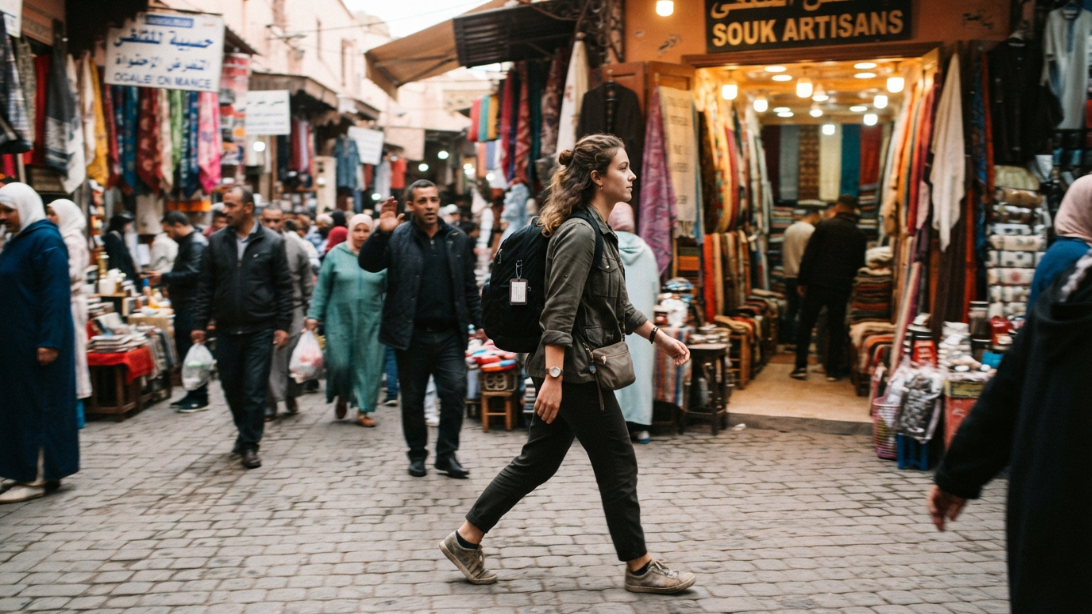
This is the safety tip that experienced solo female travelers mention most consistently and that socialization makes the most difficult to actually execute, because the politeness that most women are raised to maintain in social situations actively works against the instinct-following that personal safety requires.
The specific instinct that matters most in solo female travel safety is the one that registers a person, a situation, or an environment as wrong before the conscious mind has processed why. This instinct is not paranoia and it is not prejudice. It is pattern recognition operating faster than conscious thought, drawing on everything you’ve observed about human behavior to produce a warning that deserves to be taken seriously rather than overridden by the social pressure to seem friendly, flexible, or not difficult.
The situations where instinct-following is most important include accepting rides from strangers who offer them without being asked, continuing conversations with people whose attention feels wrong rather than merely friendly, entering vehicles or buildings that feel unsafe, and staying in social situations past the point where comfort has left. Leaving a situation, ending a conversation, crossing the street, entering a shop, or asking a nearby business for help are all entirely legitimate responses to an instinct that says something is wrong, and executing them requires no explanation, no apology, and no concern about whether the other person’s feelings are hurt by your departure.
4. Choose Accommodation With Specific Safety Criteria in Mind
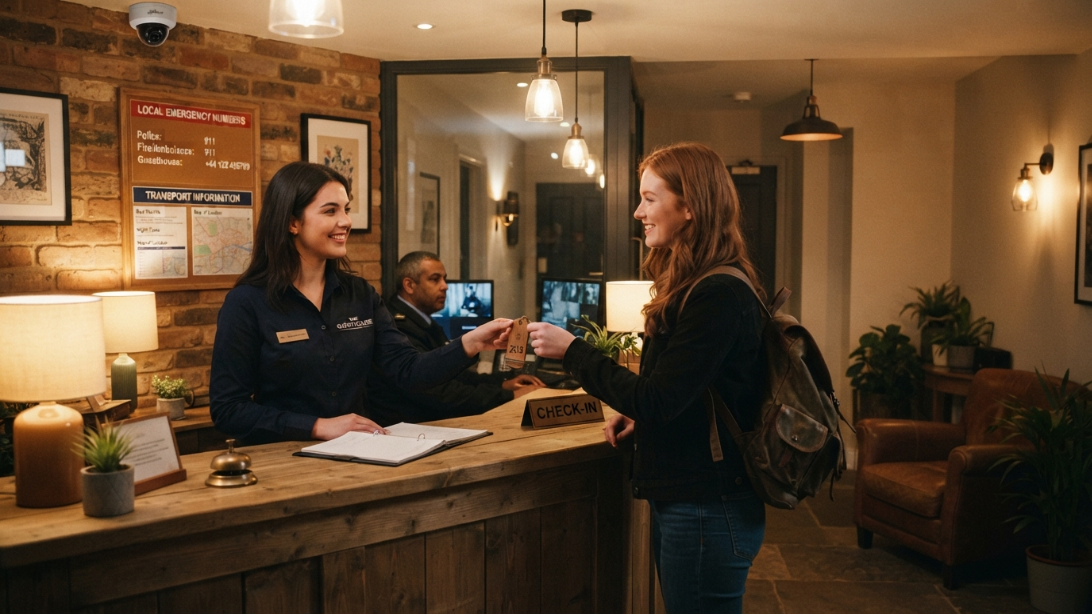
Accommodation choice for solo female travelers involves safety considerations that couple and group travelers don’t need to apply with the same specificity, and applying them deliberately produces a meaningfully safer accommodation environment than choosing based on price and reviews alone.
The specific safety criteria worth prioritizing when booking accommodation as a solo female traveler include a 24-hour staffed front desk rather than self-check-in through a lockbox, which provides a human presence and a point of contact throughout the night. A room above the ground floor with a working lock on both the main door and any windows accessible from outside. A property in a neighborhood that experienced travelers specifically identify as safe for solo female travelers rather than one that is merely generally popular. Female-only dormitories in hostels where applicable provide a social environment specifically designed for solo female travelers that mixed dormitories don’t.
Reviews specifically written by solo female travelers filtered through TripAdvisor or Booking.com provide the most relevant accommodation safety assessment available because they describe the specific experience of being a woman alone at the property rather than the general guest experience. Telling the accommodation you are traveling alone at check-in rather than keeping it private sounds counterintuitive but produces practical benefits, specifically that staff are more attentive to your presence and absence and more likely to notice and respond if something seems wrong.
5. Use Transportation Strategically and Safely
Transportation is the activity during which solo female travelers are most vulnerable to the specific safety risks that solo travel creates, and using it strategically rather than defaulting to whatever is most convenient or least expensive addresses this vulnerability directly.
Rideshare apps including Uber and Lyft internationally are consistently safer than unmarked taxis for solo female travelers in cities where they operate because they provide the driver’s name, photo, and vehicle information before you enter the vehicle, allow real-time location sharing with your trusted contact through the app, and create a digital record of the journey that street-hailed taxis don’t. Before entering any rideshare, verify that the driver’s name, photo, and license plate match the information displayed in the app.
Scammers in popular tourist cities sometimes position themselves near legitimate rideshare pickup areas and call out passenger names they’ve overheard from nearby legitimate rideshare conversations. Sitting in the back seat rather than the front provides more control over your exit and more physical distance from the driver. Sharing your trip in real time through the rideshare app’s safety feature, which sends your live location and trip details to a contact, should be a default action rather than an emergency measure. Night transport deserves the most caution, and the extra cost of a rideshare over public transport at night is genuinely worth paying for the additional safety layer it provides.
6. Manage Your Visible Wealth and Digital Profile
The visible display of expensive items and the public sharing of real-time location information are two of the most controllable risk factors in solo female travel safety, and managing both deliberately reduces the opportunistic targeting that both invite.
Visible wealth management means leaving expensive jewelry at home rather than packing it for a trip where it primarily creates risk rather than enjoyment. It means carrying a camera in a plain bag rather than around the neck on a branded strap that advertises its value to everyone in viewing distance. It means using a phone that doesn’t require active security to prevent theft from being catastrophic, which means having Find My iPhone or Google Find My Device activated and your phone backed up before departure so that phone theft produces inconvenience rather than total data loss.
Digital profile management for solo female travel safety means not posting real-time location information on social media during the trip, specifically not posting “just arrived at this guesthouse in this city” until you’ve left rather than upon arrival, and not sharing detailed itinerary information publicly that tells anyone following your accounts exactly where you’ll be and when. Posting travel content with a time delay of 24 to 48 hours eliminates the real-time location disclosure while still allowing the social sharing that most travelers enjoy.
7. Learn Basic Phrases in the Local Language
Language competence as a safety tool is one of the most consistently overlooked strategies in solo female travel safety advice, which focuses heavily on technology and behavior while undervaluing the specific safety benefit that the ability to communicate basic needs, ask for help, and navigate socially produces in the local language.
The specific phrases most relevant to solo female travel safety in any language include how to say that you are not interested and want to be left alone, how to ask for help from a bystander or shopkeeper, how to direct a taxi or rideshare driver, how to ask where the nearest police station or hospital is, and how to communicate a basic emergency.
Google Translate with offline language packs downloaded before departure provides backup for situations beyond these basics, but the specific phrases above are worth committing to memory rather than relying on having phone access and a working app in the moment when they’re needed. Speaking the local language, even imperfectly, produces a specific social effect in most cultural contexts where it reduces the perception of vulnerability that being visibly foreign creates and increases the likelihood that bystanders respond helpfully in an uncomfortable situation because the language connection has established a basic human rapport that complete language incomprehension doesn’t provide.
8. Carry a Specific Safety Kit That Addresses Real Scenarios
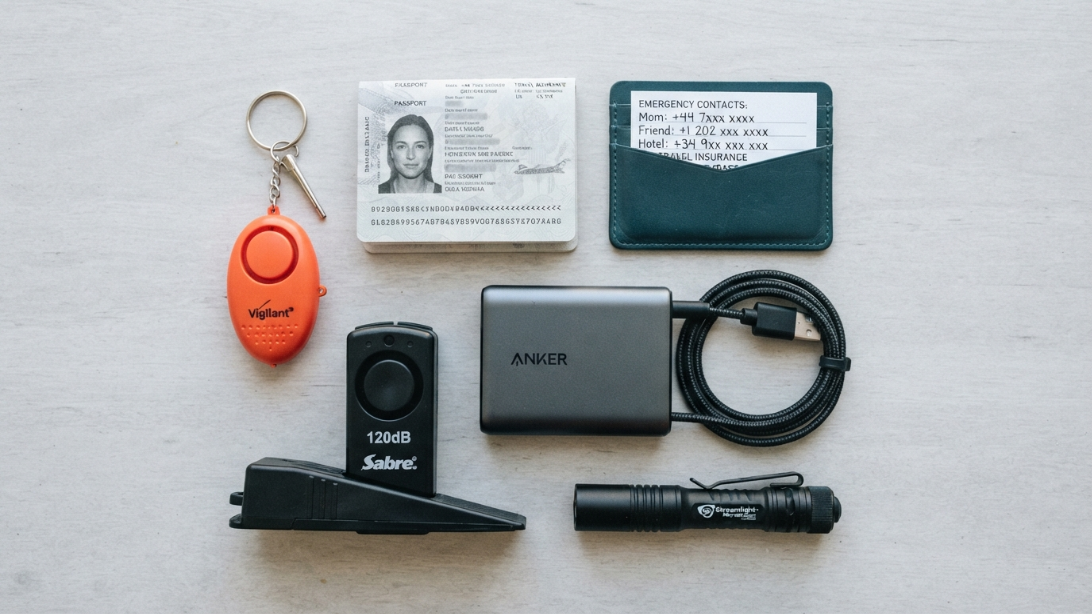
The safety equipment carried by solo female travelers is frequently either nothing at all or the kind of elaborate kit that gets packed optimistically and never accessed because it’s in the bottom of a checked bag. The practical middle ground is a small, accessible kit that addresses the specific scenarios most likely to require it.
The kit worth carrying in a bag pocket rather than buried in luggage contains the following specific items. A personal alarm like the She’s Birdie or SABRE personal alarm that produces 130 decibels of sound when activated, which is loud enough to attract attention in most environments and to startle an aggressor enough to create the seconds needed to move away. A door alarm like the GE Personal Security Window and Door Alarm that wedges under any hotel room door and triggers loudly if the door is opened, which addresses the specific concern about hotel room security that solo female travelers frequently identify.
A charged portable power bank because the scenarios where you most urgently need your phone are precisely the scenarios where low battery has become a problem. A small flashlight for navigating unfamiliar accommodation at night and as a backup in power outage situations. A photocopy of your passport kept separately from the original because losing the original without any backup documentation creates a recovery situation significantly more complicated than losing the original with a copy available.
9. Build a Local Social Network Quickly After Arrival
Social isolation is the specific vulnerability that solo female travel creates that group travel doesn’t, and actively building even a minimal local social network in the first 24 hours after arrival meaningfully reduces this vulnerability while simultaneously improving the travel experience.
The most practical ways to build local social connection quickly include introducing yourself to the hostel or guesthouse staff who know the local environment and who provide an immediate informed point of contact for questions, concerns, and navigation help. Joining the walking tours that most cities offer in free or low-cost formats that reliably produce brief connections with other travelers who are often willing to share dinner or explore together afterward.
Connecting through Meetup, Couchsurfing’s social events feature, or Bumble BFF in destination cities with other travelers or locals who are specifically open to meeting visitors. Female traveler Facebook groups for specific destinations connect solo female travelers who are simultaneously in the same city and looking for the same kind of brief social connection. The safety benefit of social connection is not primarily the physical safety that numbers sometimes provide but the practical local knowledge that people already oriented to a place share freely, specifically which neighborhoods feel uncomfortable at night, which transport is reliable, which guesthouses the other travelers trust, and what the specific local situations to be aware of are.
10. Know Your Emergency Resources Before You Need Them
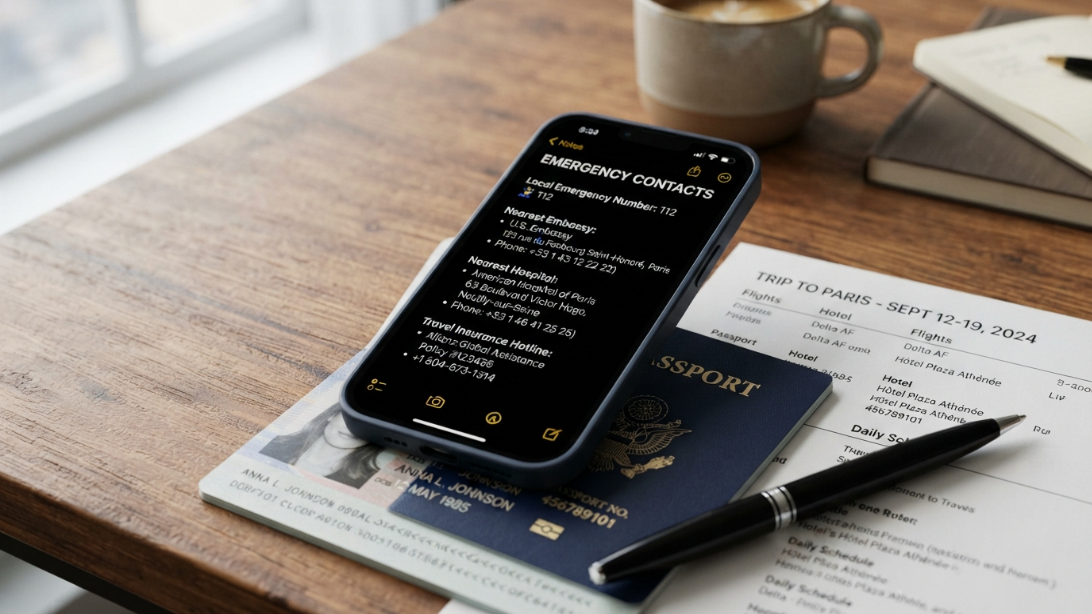
Emergency resource knowledge that hasn’t been gathered before an emergency is emergency resource knowledge that can’t be accessed during one, which is the specific practical argument for doing this preparation before departure rather than assuming you’ll figure it out if necessary.
The emergency information worth knowing before arriving anywhere includes the local emergency phone number, which is not 911 in most countries and which a panicked brain under stress does not reliably retrieve for unfamiliar numbers. The location of your country’s nearest embassy or consulate and its emergency contact number, which provides assistance including emergency passport replacement, help contacting family, and lists of local attorneys and doctors if needed. The address and phone number of the nearest hospital with emergency services at your accommodation.
Saving all of this information in your phone in a clearly labeled contact and in a note that doesn’t require internet access to open means it’s available in the offline situations where emergencies sometimes occur. The STEP program, Smart Traveler Enrollment Program administered by the US State Department, allows American travelers to register their trip with the nearest embassy and receive safety alerts for their destination while making it easier for the embassy to contact them in an emergency. Equivalent programs exist for UK citizens through the Foreign Commonwealth and Development Office, for Australians through Smartraveller, and for Canadian citizens through Registration of Canadians Abroad.
Frequently Asked Questions
What are the safest countries in the world for women traveling alone abroad?
Japan, Iceland, New Zealand, Portugal, Ireland, Taiwan, and the Scandinavian countries consistently rank among the safest destinations globally for solo female travelers based on both crime statistics and the firsthand reports of women who have traveled there independently. Safety is genuinely high in all of these destinations by objective measures, and the cultural attitudes toward women in public spaces are specifically welcoming in ways that safety statistics alone don’t fully capture.
How do solo female travelers handle harassment when it occurs?
The most effective response to street harassment in most cultural contexts is firm, direct non-engagement rather than either aggressive response or apologetic explanation. Walking purposefully without making eye contact, entering the nearest shop or café if the situation feels threatening, and asking a nearby woman for help are all more effective than engaging with the source of the harassment. In situations that escalate beyond verbal harassment, a personal alarm and moving toward populated areas where bystanders are present are the immediate practical responses before contacting local emergency services if necessary.
Should solo female travelers tell people they meet that they’re traveling alone?
Generally no, and specifically not immediately upon meeting strangers in contexts where the information is unnecessary. A common strategy among experienced solo female travelers is saying that a partner or friend is meeting them later or is at the hotel when the question is asked by someone whose intentions are unclear. This is not deception in a meaningful moral sense. It is managing the specific vulnerability that being identifiably alone in an unfamiliar environment creates, and it is entirely reasonable to use.
What travel insurance do solo female travelers specifically need?
Travel insurance for solo female travelers should specifically cover medical evacuation, which is expensive without insurance and genuinely necessary in remote or medically limited destinations. Trip cancellation coverage protects the full trip cost. Medical coverage provides access to care abroad. World Nomads covers adventure activities and is popular among solo female travelers. Battleface and Allianz Travel Insurance both offer policies worth comparing for destinations with higher risk profiles. Read exclusions carefully because standard policies frequently exclude certain activities and certain destinations that may be relevant to your specific trip.
How do solo female travelers manage anxiety about safety without letting it dominate the experience?
Completing the preparation including the safety kit, the itinerary share, the emergency resource research, and the accommodation selection using the safety criteria above produces the specific psychological relief that comes from having addressed the controllable risk factors. The anxiety that persists after thorough preparation is almost always disproportionate to the actual remaining risk rather than an accurate signal about genuine danger. The first solo trip changes the relationship with this anxiety more than any preparation does, because firsthand evidence that the world is manageable and generally welcoming to a solo woman traveling through it is the only thing that fully recalibrates the threat perception that unfamiliarity inflates before departure.
Conclusion
Solo female travel is one of the most genuinely rewarding experiences available to anyone who does it, and the safety strategies on this list exist not to make it more frightening but to make it more free, specifically the freedom that comes from knowing you’ve prepared thoughtfully enough that you can give your full attention to the experience rather than spending it managing anxiety about what you might have missed. The world is more welcoming than the worry suggests, and the first trip changes everything about what feels possible afterward. Where are you going, and what’s the one thing on this list that you hadn’t thought of before reading it?