

The best cheap flight booking tips for last minute travelers exist in a genuinely useful middle ground between the myth that last-minute flights are always expensive and the fantasy that incredible deals appear effortlessly for spontaneous people who just believe in the universe hard enough. I have booked flights within 48 hours of departure for under $100 that my friends planned months in advance and paid $400 for, and I have also paid embarrassing prices for last-minute flights that taught me specific lessons about when the system works in your favor and when it does not. The difference between those two outcomes is almost entirely about knowing which tools to use, which routes to target, and which timing patterns airlines actually follow when clearing inventory before departure.
Understand How Last Minute Flight Pricing Actually Works
Most people operate on one of two incorrect assumptions about last-minute flight pricing. Either they believe airlines always drop prices close to departure to fill empty seats, or they believe last-minute flights are always expensive because airlines know you are desperate. Both are partially true in specific circumstances, and understanding which circumstance you are in determines whether last-minute booking works in your favor.
Airlines use dynamic pricing algorithms that adjust fares based on remaining seat inventory, historical booking patterns for that specific route and date, competitive pressure from other airlines on the same route, and how far in advance the departure falls. On routes with consistent high demand, fares rise as the departure approaches because the algorithm correctly predicts that business travelers booking at the last minute will pay premium prices for available seats. On routes with lower demand or flights that are tracking below historical booking pace, the algorithm may release lower fares in the final seventy-two hours to stimulate demand and avoid flying with empty seats that produce zero revenue.
The practical implication is that last-minute deals exist reliably on leisure routes with flexible demand, specifically vacation destinations where travelers can choose when to go rather than routes dominated by business travel where departure timing is fixed by external schedules. A last-minute flight from New York to Cancún has a better chance of a deal than a last-minute flight from New York to Chicago on a Tuesday morning, because the Chicago route serves business travelers who pay whatever the seat costs while the Cancún route serves leisure travelers who might book if the price drops enough.
1. Use Google Flights as Your Primary Search Tool
Google Flights is the most powerful publicly available flight search tool for last-minute travelers and the one whose features are most consistently underused by people who open it, enter their destination, and look at prices without exploring the functionality that actually finds deals.
The Explore map feature is the specific tool that transforms Google Flights from a price lookup tool into a deal discovery tool. Navigate to the Explore section, set your departure city, select your travel dates or a flexible date range, and let the map populate with prices to hundreds of destinations simultaneously. For a last-minute traveler with flexible destination preferences, this view shows every affordable option from your departure city in the relevant date window in a single visual interface rather than requiring sequential searches for individual destinations.
The flexible dates grid shows prices for every day in a monthly calendar view for a specific route, which for last-minute travelers with one to three days of flexibility can reveal fare differences of $100 to $300 between adjacent departure days on the same route. A Friday departure that costs $380 might show $195 on Saturday or $220 on Thursday, and the flexible dates grid makes this comparison immediate rather than requiring individual date searches.
Price tracking through Google Flights sends email notifications when fares change for a specific route and date combination, which for last-minute travelers means setting alerts the moment you identify a target destination and receiving immediate notification if a price drop occurs in the days before your intended departure. Set alerts for your target route and check them three times daily in the final seventy-two hours before departure.
2. Check Scotts Cheap Flights and Going Immediately
Going, formerly Scott’s Cheap Flights, is the fare alert service that catches the specific category of deal that search tools miss: mistake fares, flash sales, and algorithmic pricing errors that exist for hours before airlines correct them. The free tier covers a subset of deals. The premium tier at $49 per year covers the full deal library and is the single subscription that most frequent flyer communities consistently recommend as worth the annual cost.
The specific value Going provides for last-minute travelers is the Last Minute Deals filter that surfaces departures within fourteen days from your departure airports. These are deals that the Going team has verified represent genuine savings of 40 to 70 percent below the normal fare for those routes, not marginal discounts that look impressive only when compared to the highest historical price. A Going last-minute deal for a flight from Chicago to Reykjavik at $280 round trip instead of the usual $680 is the kind of fare that pays the annual subscription cost in a single booking.
The critical behavior for catching Going deals is acting within hours of receiving the alert. Mistake fares and flash sales disappear when airlines notice them or when inventory sells through. A deal that exists at 2 PM may not exist at 6 PM. Having your payment information saved, your travel dates roughly decided, and your passport current eliminates the friction that causes people to lose deals while gathering information they should have had ready.
3. Search Alternate Airports Within Driving Distance
The airport you consider your home airport is almost never the only option within a reasonable driving distance, and the fare difference between adjacent airports on the same travel dates can be substantial enough to justify a one to two hour drive without meaningful friction.
A traveler in Los Angeles has access to LAX, Burbank, Long Beach, Ontario, and Orange County airports within an hour to ninety minutes of driving. A traveler in New York has access to JFK, LaGuardia, Newark, and Stewart airports, and with a longer drive, Philadelphia opens significantly different route options. A traveler in Washington D.C. has access to Dulles, Reagan National, and Baltimore, each of which serves different airlines with different route networks and pricing.
Searching all alternate airports simultaneously rather than sequentially is most efficient through Kayak or Google Flights, both of which allow multi-airport search from the departure city field. Enter all relevant airport codes separated by commas in the departure field and the search returns the cheapest option across all airports simultaneously. The fare difference between LAX and Burbank for a specific route can reach $150 to $200, which more than covers parking and gas for the drive even at last-minute booking timing.
Best Cheap Flight Booking Tips for Last Minute Travelers Using Budget Airlines
Budget airlines operate pricing models fundamentally different from legacy carriers and require different search behavior to use effectively for last-minute booking.
Spirit, Frontier, and Allegiant for Domestic US Travel
Spirit Airlines, Frontier Airlines, and Allegiant Air all release unsold inventory at steep discounts in the final seventy-two hours before departure, and this behavior is more consistent across these carriers than among legacy airlines because their revenue models depend more heavily on high load factors and less on premium business travel revenue.
Spirit’s $9 Fare Club at $69.95 per year provides access to last-minute fares and promotional deals before they are released to the general public. For travelers who fly Spirit more than twice annually, the membership typically pays for itself on a single booking during a promotional fare window. Frontier’s discount den at $59.99 per year functions similarly. The critical caveat for both carriers is understanding the fee structure before booking: Spirit and Frontier’s advertised base fares exclude carry-on bags, seat selection, and in some cases printed boarding passes. Adding a carry-on bag to a Spirit booking costs $45 to $65 at the airport versus $35 to $55 online at booking. Including this fee in the price comparison against legacy airlines prevents the specific disappointment of discovering the total price at the gate.
Ryanair and Wizz Air for European Last-Minute Travel
Ryanair and Wizz Air in Europe release seat sales that include last-minute inventory at prices that make European spontaneous travel financially realistic in ways that legacy carrier pricing never allowed. Ryanair’s seat sales announced via email newsletter and Twitter provide the earliest access to promotional pricing. Following @Ryanair and @wizzair on social media and subscribing to their email newsletters is the lowest-effort method for catching last-minute European deals.
The same fee-awareness that applies to US budget carriers applies here with European specifics: Ryanair charges for priority boarding that provides carry-on bag access, and without this add-on only a small personal item is included in the base fare. A €19 base fare that requires €25 of add-ons to be functional costs €44, which compared accurately to a legacy carrier fare often remains competitive but is not the €19 that the headline advertises.
4. Book One-Way Flights and Mix Airlines

The reflexive behavior of searching for round-trip flights on a single airline produces a specific blind spot in last-minute fare searching: it forces you to find a deal simultaneously on both the outbound and return leg from the same carrier, which is significantly less likely than finding an outbound deal on one carrier and a return deal on a different carrier.
Booking one-way flights on separate airlines, sometimes called hacker fares, allows you to combine the cheapest available outbound option with the cheapest available return option regardless of which airline operates each. Kiwi.com specifically builds itineraries that mix airlines including budget carriers that major search tools do not always combine, and guarantees connections between airlines that do not officially interline, which is the specific coverage gap that makes mixing airlines feel risky and that Kiwi’s protection addresses.
The savings from mixing airlines on last-minute bookings can reach $100 to $200 compared to forcing a round trip on a single carrier when the cheapest round-trip option is significantly more expensive than the sum of the cheapest one-way options. Running this comparison takes three additional minutes of search time and produces better outcomes often enough to make it standard practice for last-minute booking.
5. Use the 24 Hour Rule Strategically
The US Department of Transportation requires airlines to allow cancellation within 24 hours of booking for tickets purchased at least seven days before departure with a full refund. This rule creates a specific strategic opportunity for last-minute travelers that most people never think to use.
When you identify a potential flight but are not fully committed to the trip yet, book and hold for 24 hours rather than waiting to decide while the fare may increase. If the decision becomes affirmative within 24 hours, keep the booking. If circumstances change, cancel for a full refund. This converts a 24-hour window of uncertain decision-making from a period of watching fares potentially increase into a period of holding a guaranteed price while finalizing plans.
The limitation is the seven-day rule: the 24-hour cancellation right applies only to bookings made seven or more days before departure, which for true last-minute travelers within that window does not apply. For travelers in the two-week window rather than the final forty-eight hours, this rule provides genuine flexibility. Some airlines extend this protection voluntarily to shorter booking windows as a customer service policy: Delta and United both have histories of honoring 24-hour holds even within seven days of departure for elite status members and occasionally for general customers, which is worth a brief customer service call to verify before deciding against booking.
6. Set Up Alerts on Multiple Platforms Simultaneously
No single fare alert platform catches every deal for every route because each aggregates data differently, covers different airline partnerships, and uses different threshold definitions for what constitutes an alert-worthy price. Setting alerts on multiple platforms simultaneously creates redundant coverage that catches deals any single platform might miss.
Google Flights price tracking catches fare changes on specific routes and dates. Hopper uses predictive algorithms to recommend whether to book now or wait based on historical price patterns and sends alerts when prices reach predicted lows. Kayak price alerts cover a slightly different set of airline partnerships. Airfarewatchdog specifically covers unadvertised sales and fare mistakes that algorithmic platforms sometimes miss because they require human review to identify as genuinely deal-worthy. Running all four simultaneously for your target route in the week before intended departure creates comprehensive coverage with minimal additional effort beyond the initial setup.
Hopper deserves specific mention for last-minute travelers because its Freeze feature allows you to lock a current fare for a small fee, typically $5 to $20, for a specific hold period. If the fare increases within the hold period, Hopper covers the difference up to the frozen amount. If the fare decreases, you pay the lower price. For last-minute travelers who have identified a reasonable fare but want to continue monitoring for potential drops without risking a price increase, Freeze provides the specific insurance that uncertainty about last-minute pricing creates.
7. Travel on the Cheapest Days and Times Within Your Window

Last-minute flexibility extends in two directions: destination flexibility, which destination alerts and explore maps address, and departure timing flexibility within a fixed destination choice. Even within a forty-eight to seventy-two hour last-minute booking window, the specific departure day and time within that window affects the available fare significantly.
Tuesday and Wednesday departures are consistently the cheapest days of the week for domestic US flights and most international leisure routes, because they serve the lowest demand volume of any weekday. Saturday departures are the second cheapest because leisure travelers who prefer Friday departures have reduced pressure on Saturday inventory. Friday afternoon and Sunday evening are the most expensive departure windows because they serve the highest demand concentration of business and leisure travel simultaneously.
Very early morning departures, specifically those before 7 AM, and late night departures after 9 PM consistently price lower than midday and early evening departures on the same day for the same route. The practical discomfort of a 5:30 AM departure is a reasonable trade for a $60 to $120 fare reduction that a last-minute traveler on a tight budget should evaluate honestly rather than reflexively dismissing.
Red-eye flights on overnight routes combine the cheapest departure timing with the elimination of one night’s accommodation cost, which for last-minute travelers who have not yet booked destination accommodation represents a combined saving of the fare difference plus the accommodation night. A red-eye from Los Angeles to New York that costs $30 less than the afternoon departure and saves a $100 New York hotel night is a $130 effective saving that makes the overnight discomfort straightforwardly worthwhile.
8. Use Airline Apps and Sign Up for Flash Sales
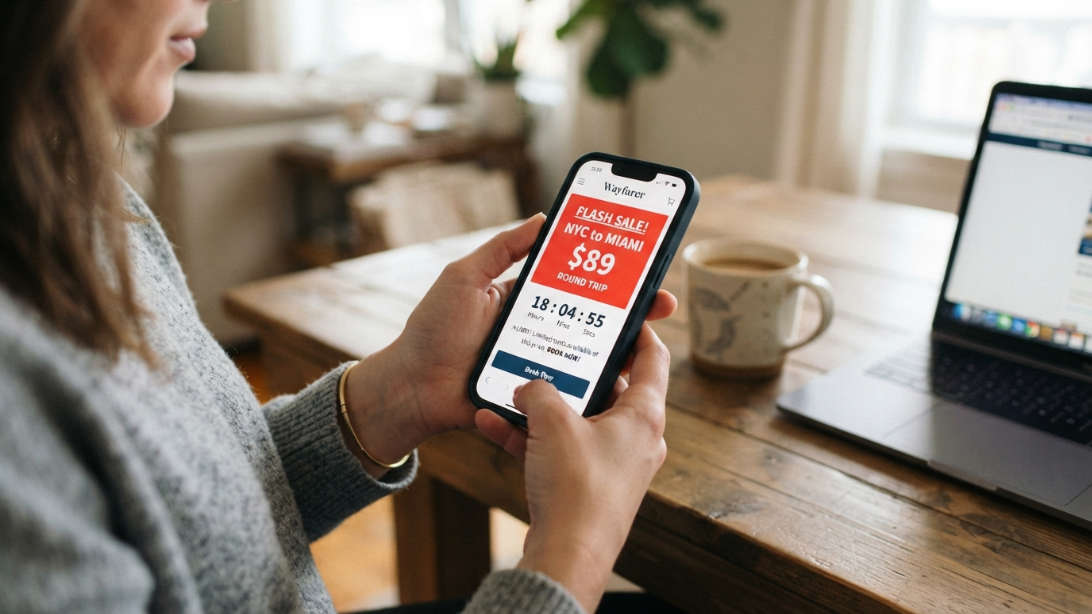
Airlines release app-exclusive deals and flash sales through their owned channels before and sometimes instead of distributing them to third-party search aggregators. Being present in the airline’s ecosystem when these deals release requires minimal setup and provides occasional access to inventory that aggregators never index.
Southwest Airlines operates entirely outside major flight aggregators and must be searched directly through Southwest.com or the Southwest app. Southwest’s Wanna Get Away fares are some of the consistently lowest domestic US fares available and are invisible to Google Flights, Kayak, and every other aggregator. A last-minute traveler who does not check Southwest directly is missing an entire airline’s worth of inventory in the domestic US market.
Alaska Airlines Mileage Plan members receive sale alerts that include last-minute inventory not available to non-members. JetBlue’s TrueBlue program sends flash sale notifications to members that expire within 24 to 48 hours and cover routes where the airline has excess inventory. Delta’s SkyMiles program sends similar alerts. Joining every airline’s frequent flyer program costs nothing, requires only an email address and five minutes per airline, and creates a passive alert system that catches deals across multiple carriers with no ongoing effort beyond the initial signup.
9. Consider Nearby Destination Flexibility

The most powerful last-minute flight booking position is genuine destination flexibility combined with a specific date rather than a specific destination combined with flexible dates. Airlines release deals on specific routes based on inventory needs that do not distribute evenly across all routes simultaneously, and a traveler willing to go to whichever warm-weather beach destination has the best deal on a specific weekend accesses a significantly larger pool of potential deals than one who has decided they want Cancún specifically and will only book Cancún.
Google Flights Explore, Kayak Explore, and the Skyscanner Everywhere search all implement this approach by showing the cheapest available destination from your departure airport on your target dates across a map interface. These tools are the technological implementation of destination flexibility: they answer the question “where can I go from here on these dates for the least money” rather than “how much does a specific destination cost.”
The psychological shift required to use these tools effectively is treating the destination as the output of the search rather than the input. This is counterintuitive for most travelers who have a destination in mind before they search, but for last-minute travelers motivated primarily by the desire to travel rather than a fixed desire to reach a specific place, it is the behavior that produces the most genuinely impressive last-minute fares.
Frequently Asked Questions
What are the best cheap flight booking tips for last minute travelers who need to fly within 24 hours?
Within 24 hours, search directly on airline websites rather than aggregators because some last-minute inventory appears in airline direct channels before it reaches aggregators. Check Southwest directly if flying domestically in the US. Look for standby and same-day change options if you have any flexibility on departure time within the day. Budget airlines including Spirit and Frontier sometimes release deeply discounted seats in the final hours before departure to fill remaining capacity, which Hopper’s Watch feature tracks in real time.
Is it cheaper to book last minute or in advance for international flights?
For most international routes, advance booking of six to twelve weeks produces the lowest fares consistently, and last-minute international deals are less predictable than domestic ones. The exception is international leisure routes served by budget carriers including transatlantic routes on PLAY and Norse Atlantic, where last-minute inventory sales do occur. Mistake fares through Going and Airfarewatchdog represent the most reliable path to genuinely cheap last-minute international fares, but they require flexibility to act within hours of the alert.
Do incognito browsing and VPNs actually lower flight prices?
The honest answer is: sometimes marginally, not reliably. Airlines use cookies to track repeated searches and may display higher prices to users who have searched the same route multiple times, which is the behavior that incognito mode addresses. A VPN that changes your apparent location to a country with lower average purchasing power may surface lower regional fares on some international routes. Neither technique produces the dramatic savings that viral social media posts claim, and the consistent application of the tools and strategies in this article produces better results than either technique.
Which airline credit card is most useful for last minute travelers specifically?
The Capital One Venture X at $395 annual fee with $300 travel credit effectively costs $95 and provides two times miles on all purchases with transfer partners across multiple airlines, no foreign transaction fees, and Priority Pass lounge access that makes last-minute airport time significantly more comfortable. The Chase Sapphire Preferred at $95 annual fee provides strong travel insurance coverage that matters specifically for last-minute travelers whose plans are more likely to change after booking. The best card depends on which airline network matches your primary travel patterns.
Should I use a travel agent for last minute flight booking?
For complex international itineraries involving multiple airlines and connection timing that requires expertise to optimize, a travel agent with consolidator access to unpublished fares can find inventory unavailable through public search tools. For straightforward domestic and simple international routes, the tools described in this article access equivalent or better inventory without the agent fee. Fora Travel and Virtuoso-affiliated agents are worth consulting for complex multi-destination last-minute itineraries where the expertise value justifies the cost.
Conclusion
Last-minute flight booking rewards the traveler who has done the setup work before the spontaneous moment arrives: fare alert subscriptions running, airline apps installed, frequent flyer numbers registered, and payment information saved across the platforms that find the best deals fastest. The spontaneity is real. The preparation behind it is what makes it affordable rather than expensive. Which destination are you hoping the next last-minute deal takes you to?