
Finding genuinely useful practical tips for packing light on long trips requires cutting through the minimalist travel content that either treats packing light as a personality trait you either have or don’t, or provides advice so extreme that following it means arriving at a two-week trip with three items of clothing and the vague optimism that laundry will somehow work out. Packing light on a long trip is a learnable skill with specific techniques that produce specific results, and the gap between the overpacked traveler dragging a massive suitcase through cobblestone streets and the same person returning from a subsequent trip with a single carry-on is almost entirely a function of learned strategies rather than innate minimalism. I overpacked spectacularly for years before figuring out what actually works, and every tip on this list comes from that specific journey.
Understand Why Overpacking Happens Before Trying to Fix It
Before any specific packing strategy lands usefully, understanding the psychological mechanisms that produce overpacking in the first place makes the solutions more intelligible and more sustainable than treating them as arbitrary rules to follow.
Overpacking is almost never about genuinely needing everything packed. It is almost always about anxiety management. The suitcase filled with every possible item for every possible scenario provides the same psychological comfort as the seventeen-tab planning spreadsheet, the feeling of having controlled every variable and prepared for every contingency. The problem with this anxiety management strategy applied to packing is that it produces a bag so heavy and so unwieldy that the trip itself becomes harder rather than more comfortable, which is the opposite of what the anxiety was trying to achieve.
The specific anxieties that most consistently produce overpacking include the fear of being cold or unprepared for weather changes, the fear of not having the right outfit for an unexpected occasion, the fear of needing something specific that isn’t available at the destination, and the general fear of being caught without something in an unfamiliar environment where obtaining it feels uncertain. Identifying which specific anxiety is driving the packing decisions allows those decisions to be addressed directly rather than through the blunt instrument of simply packing everything.
1. Choose the Right Bag Before Deciding What to Pack
The bag is the decision that determines every subsequent packing decision, and choosing it after deciding what to pack rather than before produces a bag sized to anxiety rather than to genuine need.
Choosing a smaller bag than you think you need and committing to packing only what fits within it is the single strategy that produces the most dramatic and most immediate packing light result. The human brain fills available space with items that justify filling it, which means a large suitcase will always be filled to capacity regardless of trip length or destination because the available space reads as space that should be used. A carry-on sized bag of 35 to 45 liters eliminates this dynamic by creating a constraint that requires genuine prioritization rather than the optimistic everything-might-be-useful approach that larger bags enable.
The specific bags worth considering for long trip carry-on travel include the Osprey Farpoint 40 and Faraway 40 for their excellent organization and carry-on compliance across most international carriers, the Away Carry-On for hard-shell protection of its contents and its built-in battery for device charging, and the Tortuga Setout 35 for its laptop compartment and front-loading access that makes packing and unpacking in hotel rooms faster than top-loading backpacks. Measuring your chosen bag against the carry-on dimensions of the most restrictive airline on your itinerary before departure prevents the gate-check situation that turns a carry-on strategy into a checked bag reality.
2. Build Your Wardrobe Around a Deliberate Color Palette
The clothing packing problem is not primarily a volume problem. It is a coordination problem, and solving the coordination problem through a deliberate color palette reduces the volume required as a direct consequence.
A deliberate travel color palette means selecting one neutral base color and one or two accent colors before pulling a single item of clothing from the wardrobe, then packing only items within that palette regardless of how appealing items outside it seem while standing in front of the wardrobe. A navy base with white and camel accents means every top works with every bottom, which means eight clothing items produce significantly more outfit combinations than eight uncoordinated items that require specific pairings.
The specific clothing count that works for most long trips of two to four weeks is three to four tops, two bottoms, one versatile dress or smart layer if applicable, underwear for seven to ten days rather than the full trip length, two pairs of socks per day of expected walking, and two pairs of shoes maximum. Two pairs of shoes is the specific limit that prevents the weight and space consumption that more shoes consistently produce, with the two pairs covering the full range of planned activities specifically one comfortable walking shoe and one that handles evenings or smarter occasions. Everything beyond this baseline requires justification against the specific activities planned rather than the general desire to have options.
3. Apply the One Week Rule Regardless of Trip Length
The one week rule is the single most counterintuitive and most effective packing strategy available for long trips, and understanding why it works makes it easier to trust and apply.
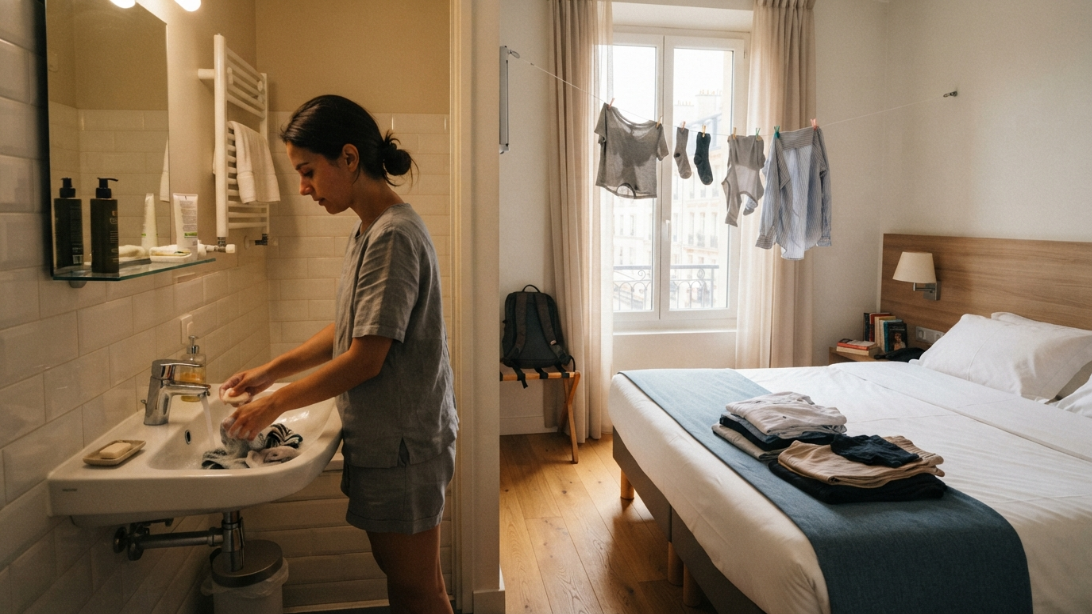
The one week rule states that the clothing packed for a two-week trip should be identical to the clothing packed for a one-week trip because the second week of any trip uses the same clothing as the first week washed and reworn rather than an entirely different set. This applies equally to a three-week and a four-week trip because laundry, whether at a laundromat, a hotel laundry service, or in a sink with travel soap, replaces packing multiples rather than requiring them.
The psychological resistance to this rule is almost always about laundry logistics feeling uncertain or inconvenient in unfamiliar environments rather than about genuine clothing need, and addressing the logistics removes the resistance. Laundromats exist in virtually every city of meaningful size in the world. Hotels with any level of service offer laundry either through the hotel or through a nearby service. Sink washing with a travel soap bar like Dr. Bronner’s or with Scrubba Wash Bag produces clean clothing from a five-minute process that dries overnight in any warm environment. Quick-dry merino wool and synthetic fabrics specifically dry faster than cotton and smell less between washes, which makes the one-week rule more comfortable to apply than it sounds before the first trip that uses it.
4. Use Packing Cubes to Organize and Compress
Packing cubes are the organizational tool that experienced light travelers mention most consistently as the single addition that most improved their packing efficiency, and they produce this improvement through two specific mechanisms that are genuinely distinct in their benefits.
Organization is the obvious benefit. Packing cubes divide a bag into dedicated zones that remain organized throughout the trip rather than collapsing into the chaotic mixing that results from weeks of unpacking and repacking without organizational structure. Finding a specific item in a packed bag without packing cubes means unpacking most of the bag. Finding the same item in a cubed bag means opening one cube. Compression is the less obvious but equally valuable benefit for packing light specifically.
Compression packing cubes from Eagle Creek, Osprey, or Peak Design compress clothing by removing air when sealed, producing a measurable reduction in the volume each clothing item occupies within the bag. The compression effect is not dramatic for individual items but accumulates across a full bag’s worth of clothing into meaningful additional space. The specific cubing system that works best for long trips uses one cube per clothing category, specifically tops, bottoms, underwear and socks, and a small spare cube for items acquired during the trip. Rolling clothing rather than folding before placing in cubes reduces wrinkles and further compresses each item beyond what flat folding achieves.
5. Apply the Wear It or Leave It Test to Every Item
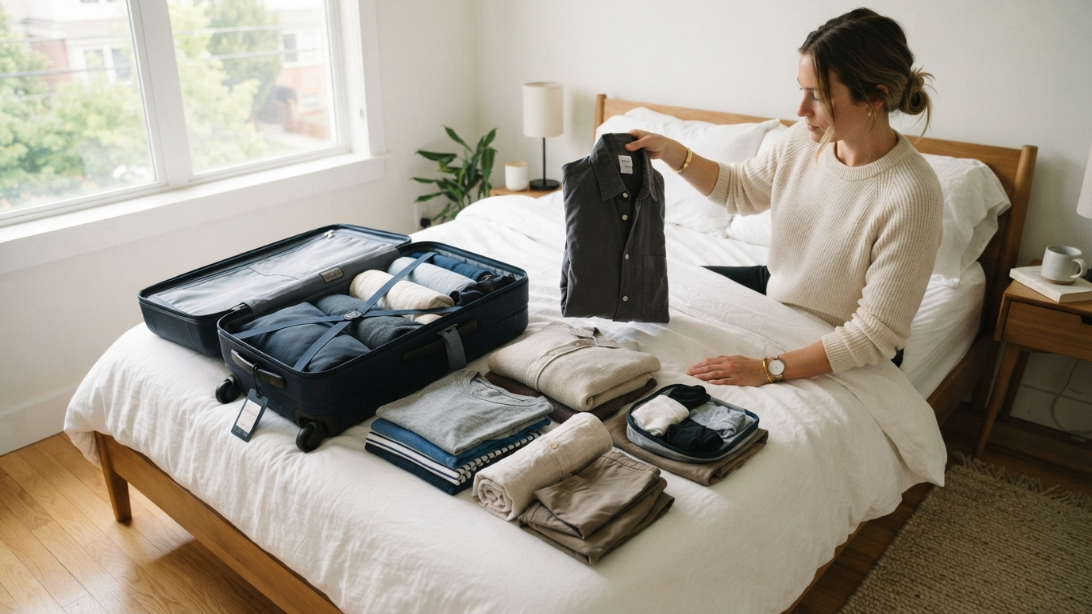
The wear it or leave it test is the most practically effective item-by-item decision tool available for packing light, and applying it ruthlessly to every item before it goes into the bag produces a final pack that contains only genuinely necessary items rather than aspirationally useful ones.
The test works as follows: hold each item and honestly answer three specific questions. Have I worn this in the last six months under conditions similar to those I’ll experience on this trip? Can I name the specific day or occasion during this trip when I will wear this? If I leave this behind and discover I need it, can I obtain it at my destination without significant difficulty or expense? An honest no to any of these three questions is sufficient reason to leave the item behind.
The third question specifically addresses the anxiety that drives most overpacking, because discovering that almost every item left behind is either available at the destination or simply not needed on the trip produces the evidence that makes subsequent packing easier. The items that most consistently fail this test include formal clothing for occasions that don’t actually occur on most trips, exercise equipment beyond a resistance band or jump rope, multiple pairs of shoes beyond the two-shoe maximum, books beyond one or two for the trip’s reading needs when an e-reader covers the same function at a fraction of the weight, and the full-size toiletry versions of items available in travel sizes or purchasable at the destination.
6. Reduce Toiletries to the Absolute Minimum
Toiletries are the packing category where the most weight accumulates for the least genuine benefit, and the strategies for reducing them produce the most immediate weight savings of any single category change.
The three-tier toiletry reduction strategy works as follows. First, switch every possible liquid toiletry to its solid equivalent. Solid shampoo bars, conditioner bars, solid sunscreen, and solid deodorant collectively replace the heaviest and most liquid-rule-restricted items in the toiletry bag in a form that weighs less, lasts longer, and passes through airport security without removal or restriction. Lush, HiBar, and Ethique all produce solid toiletry alternatives that work as well as their liquid equivalents. Second, buy toiletries at the destination rather than packing them from home.
Shampoo, conditioner, body wash, and sunscreen are available at pharmacies and supermarkets in virtually every country, and buying them on arrival eliminates their weight from the outbound journey entirely. Third, carry travel-size versions of items that genuinely cannot be substituted or purchased locally, which for most travelers reduces to prescription skincare, specific medications, and one or two specialty items that genuinely aren’t available abroad. The weight saved by transitioning to solid toiletries and destination purchases typically runs between 500 grams and one kilogram, which is meaningful within the total weight budget of a carry-on bag.
7. Pack Electronics Strategically and Ruthlessly
Electronics are the second most consistent source of unnecessary bag weight after clothing, primarily because the number of devices and cables that seem necessary during packing consistently exceeds the number that turn out to be used during the trip.
The electronic items genuinely worth carrying on a long trip are a smartphone, a laptop or tablet if work or extended content consumption requires one, a universal power adapter appropriate to the destinations visited, a portable power bank of sufficient capacity to charge a phone twice, and the specific charging cables for each device packed. Everything beyond this list requires specific justification against specific planned use. A dedicated camera is justified if photography is a primary trip purpose. An e-reader is justified if extended reading is a consistent daily habit.
A laptop is not justified if a tablet covers every intended function. The specific weight savings from electronic reduction come primarily from eliminating cables and adapters for devices that aren’t packed rather than from device reduction alone, because cables accumulate to meaningful weight across a bag packed for a long trip. A single multi-port charging hub like the Anker 737 Charger replaces multiple individual chargers and reduces both weight and the cable tangle that multiple separate adapters produce. The universal adapter is the one electronic-adjacent item worth purchasing before a first international trip if not already owned, because arriving without the right plug configuration is among the most easily avoidable first-night inconveniences available.
8. Wear Your Heaviest Items on Travel Days
This is the specific strategy that produces the most immediate weight reduction in a packed bag without requiring any item to be left behind, and it is consistently underused by travelers who pack their heaviest items rather than wearing them.
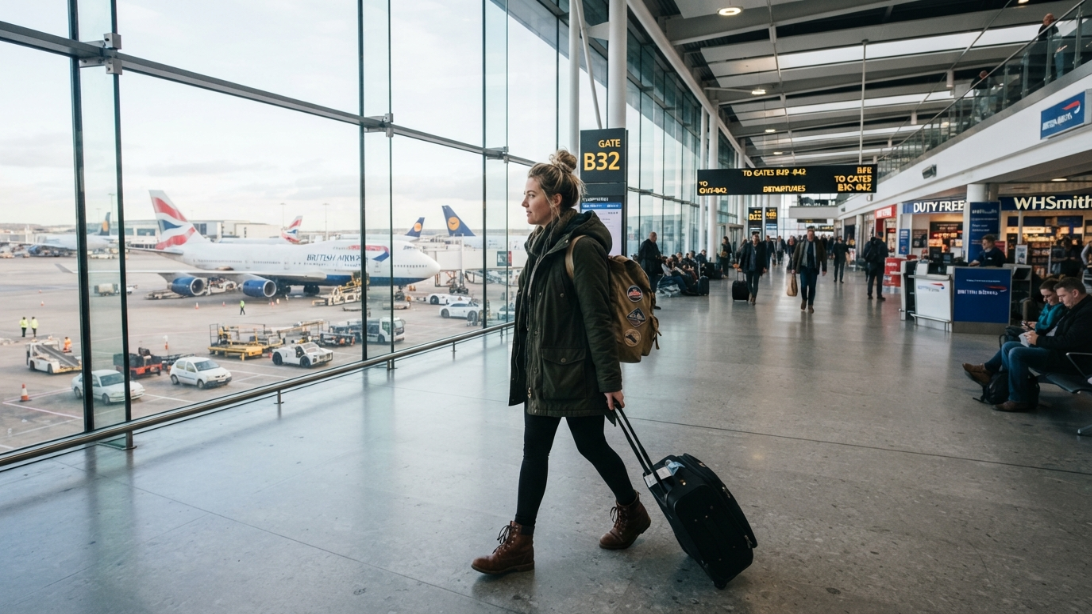
Wearing the heaviest shoes, the thickest jacket, and the heaviest jeans or trousers on every flight and every long transit day removes the items that contribute most to bag weight from the bag entirely while still having them available throughout the trip. A pair of heavy boots that weigh 800 grams in a bag weigh zero grams in a bag when worn on the feet boarding a flight.
A thick winter jacket that would consume a significant portion of a carry-on’s volume when folded occupies no bag space when worn through the airport. The specific items most worth wearing rather than packing are the heaviest pair of shoes, the heaviest outer layer, and the heaviest single clothing item in the planned wardrobe. On arrival at the destination, these items return to the bag or the wardrobe rotation in the same way any other packed item does, with no functional difference in availability throughout the trip. The technique works equally well on the return journey when items acquired during the trip have added to the bag’s weight beyond its original packing, specifically by wearing the heaviest items home rather than attempting to fit them into an already capacity bag.
9. Plan for Laundry as Part of the Trip Structure
Laundry planning is the logistical piece that makes every other packing light strategy sustainable across a long trip, and treating it as a trip planning element rather than an inconvenient interruption produces a fundamentally different relationship with both packing and the trip itself.
Planning laundry into the trip structure means identifying laundry opportunities before departure rather than hoping they appear when needed. Most cities of any meaningful size have coin laundromats identifiable through Google Maps searches for lavanderia, laundromat, or launderette at the destination. Accommodation with laundry facilities, specifically Airbnb listings with washing machines or hotels with guest laundry, can be specifically selected during booking rather than discovered accidentally after arrival.
The Scrubba Wash Bag at approximately $55 is a waterproof bag with an internal washboard that allows genuinely effective sink washing of a day’s worth of clothing in five minutes of manual agitation, which reduces laundry to a nightly five-minute routine rather than a dedicated half-day at a laundromat. The specific frequency of laundry that sustains the one-week rule across a long trip is approximately once every five to seven days, which for most trip structures means two to three laundry sessions across a two to four week journey and zero additional clothing items in the bag beyond the one-week baseline.
10. Do a Test Pack Two Weeks Before Departure
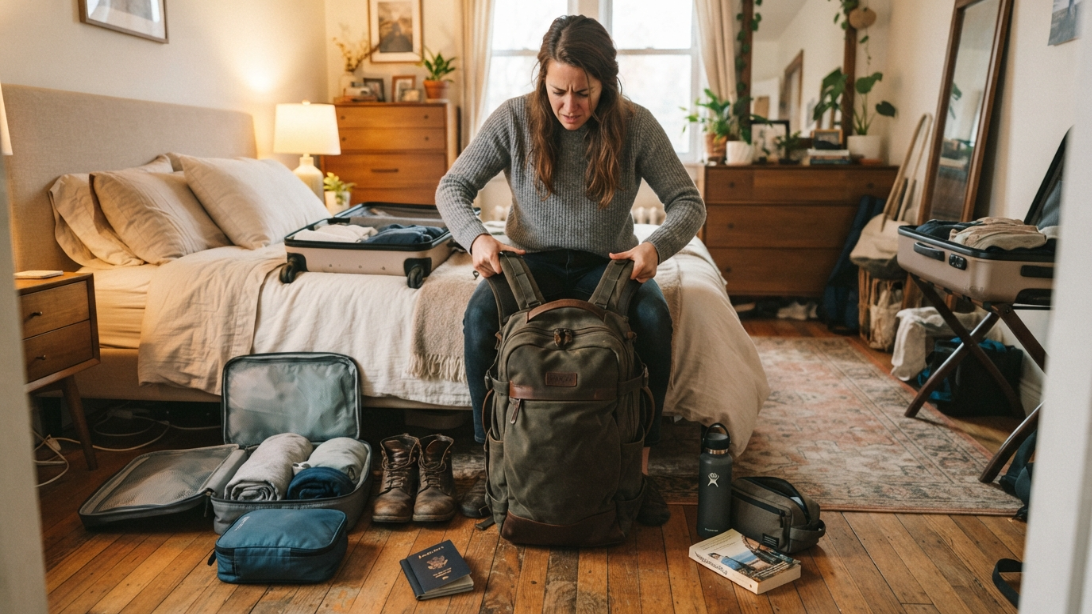
The test pack performed two weeks before departure is the single most effective quality control step available for packing light, and performing it two weeks rather than the night before departure is what makes it actually useful rather than a confirmation that the bag is too heavy with no time to address it.
The test pack process works as follows: pack everything you intend to bring exactly as you would for the actual departure. Lift the packed bag and carry it around your home for ten minutes. Walk up a flight of stairs. Put it on and take it off three times. If any of these activities produces the feeling that the bag is heavier than comfortable, items need to be removed rather than the bag being accepted at its current weight. The ten-minute carrying test specifically reveals whether the weight is sustainable across the reality of a long trip’s actual bag-carrying demands, which include airport distances, stairs without elevators, cobblestone streets, and overhead bin lifts that packed-next-to-the-bed assessments don’t replicate.
Two weeks of lead time allows items identified as unnecessary during the test pack to be genuinely removed rather than rationalized back in under the time pressure of imminent departure. It also allows items identified as missing to be purchased or borrowed before departure rather than bought at airport retail prices. Photographing the final packed contents before closing the bag creates a reference for future trips that reduces the repacking-from-scratch effort that makes each subsequent trip feel as effortful as the first.
Frequently Asked Questions
How do you pack light for a four-week trip without doing laundry constantly?
The one-week clothing rule applied to a four-week trip requires three laundry sessions rather than constant daily washing. Pack clothing for seven days, wash on day five or six of each week, and the same wardrobe sustains four weeks of travel without additional clothing. Quick-dry merino wool and synthetic fabrics reduce drying time to overnight in most environments, which makes this schedule practical without dedicated laundry days that consume significant trip time.
What are the best fabrics for packing light on long trips?
Merino wool is the most consistently recommended fabric for packing light because it regulates temperature across a wide range of conditions, resists odor significantly longer between washes than synthetic or cotton alternatives, and wrinkles less than cotton when packed. Icebreaker, Smartwool, and Uniqlo’s merino range all produce travel-appropriate merino items at various price points. Synthetic quick-dry fabrics are the best budget alternative to merino, drying faster than either cotton or wool while weighing less per garment than either.
How do you pack light when a trip includes formal events requiring specific clothing?
The specific occasion clothing problem is best solved through one of three approaches depending on the occasion. Wear the formal item on the travel day rather than packing it, which removes it from the bag entirely and arrives it wrinkle-free. Ship it to the destination hotel in advance using a luggage shipping service like Luggage Forward or Send My Bag if wearing it in transit isn’t practical. Rent appropriate clothing at the destination for a single occasion rather than carrying it for the entire trip, which is increasingly available in major cities through Rent the Runway and local suit rental services.
Is it really possible to travel for more than two weeks with only a carry-on?
Yes, and most experienced long-term travelers do exactly this regardless of trip duration because the packing strategies that make a two-week trip fit in a carry-on are identical to those that make a two-month trip fit in the same bag. Trip length adds laundry frequency rather than clothing volume when the one-week rule is correctly applied. The travelers who most consistently report that a carry-on is impossible for long trips are almost always those who haven’t yet applied the color palette coordination, the one-week rule, and the solid toiletry strategies simultaneously, any one of which alone produces partial improvement and all three together produce the full result.
What do you do when you’ve packed light and realize you’ve forgotten something important?
Most items forgotten during packing are available for purchase at the destination at prices similar to or lower than home prices. The genuinely irreplaceable items, specifically prescription medications, required travel documents, and specific medical equipment, are worth a pre-departure checklist specifically for these categories rather than for the general packing list that the packing light strategies above handle. A physical checklist of the genuinely irreplaceable items reviewed the morning of departure catches the specific forgetting that matters while leaving the low-stakes forgotten items to be purchased at the destination without stress.
Conclusion
Packing light is a skill that gets easier with every trip that uses these strategies and provides evidence that the items left behind weren’t needed after all, and that evidence accumulates across trips into the specific confidence that allows the carry-on to feel like enough rather than a compromise. The trip taken with a light bag is genuinely different from the same trip taken with a heavy one, in the freedom of movement, the ease of transit, and the specific pleasure of never waiting at baggage claim. What’s the one item you always pack and never use, and are you ready to finally leave it behind?